In short
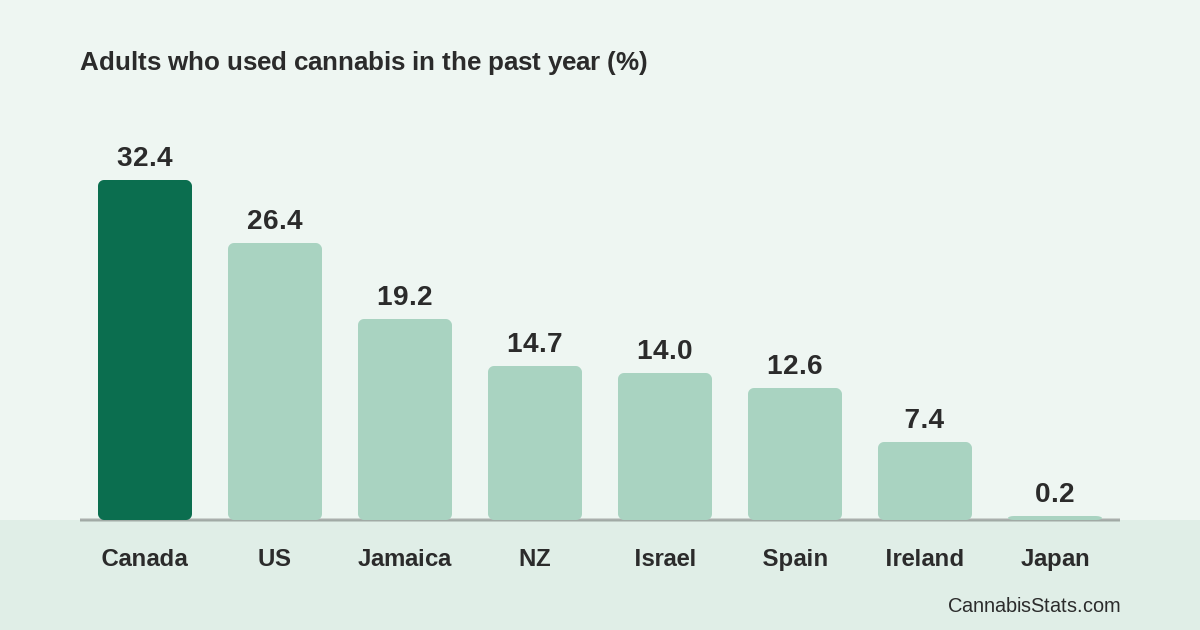
- Canada has the highest recorded rate: 32.4% of people aged 15 and over used cannabis in the past year (2023). The United States is second at 26.4% (2023).
- Japan has the lowest: 0.23% (2023). Iran, Nepal, Panama, Bolivia and Türkiye are also below 1.2%.
- 16 of the 79 countries and territories are at 10% or more. The middle value is 5.4%.
- In Western and Central Europe, Spain is highest (12.6%), and Hungary, Portugal and Greece are lowest (2.6–2.8%). Ireland is at 7.4% (2023).
How to read these numbers
Each figure comes from a national survey reported to the UN Office on Drugs and Crime (UNODC), usually a household survey. Countries survey in different years and ask different age groups: most use 15–64, but Canada's figure covers everyone aged 15 and over, and France and Italy survey 18–64. So small gaps between countries don't mean much. Large ones, such as Canada against Japan, are well outside those differences.
Surveys count what people tell interviewers. Where cannabis use is a serious offence, people are less likely to report it, so the lowest figures may be undercounts.
Every country
| Country | Past-year use | Survey year | Ages | Rank |
|---|---|---|---|---|
| Canada | 32.4% | 2023 | 15+ | 1 |
| United States | 26.4% | 2023 | 15-64 | 2 |
| Jamaica | 19.2% | 2023 | 15-64 | 3 |
| New Zealand | 14.7% | 2022 | 15-64 | 4 |
| Israel | 14.0% | 2020 | 18-86 | 5 |
| Spain | 12.6% | 2024 | 15-64 | 6 |
| Uruguay | 12.3% | 2024 | 15-64 | 7 |
| Australia | 11.6% | 2019 | 14+ | 8 |
| South Africa | 11.2% | 2017 | 15-64 | 9 |
| France | 10.8% | 2023 | 18-64 | 10 |
| Italy | 10.8% | 2022 | 18-64 | 11 |
| Nigeria | 10.8% | 2017 | 15-64 | 12 |
| Chile | 10.6% | 2024 | 15-64 | 13 |
| Morocco | 10.5% | 2017 | 15-64 | 14 |
| Monaco | 10.5% | 2017 | 18-64 | 15 |
| Argentina | 10.3% | 2022 | 16-75 | 16 |
| Czechia | 9.4% | 2023 | 15-64 | 17 |
| Finland | 9.0% | 2022 | 15-64 | 18 |
| Scotland (UK) | 9.0% | 2023 | 16+ | 19 |
| Netherlands | 8.9% | 2024 | 15-64 | 20 |
| Croatia | 8.8% | 2023 | 15-64 | 21 |
| Germany | 8.8% | 2021 | 18-64 | 22 |
| Switzerland | 7.6% | 2022 | 15-64 | 23 |
| Liberia | 7.5% | 2017 | 15-64 | 24 |
| Ireland | 7.4% | 2023 | 15-64 | 25 |
| Belgium | 7.0% | 2018 | 15-64 | 26 |
| Norway | 6.9% | 2024 | 16-64 | 27 |
| Costa Rica | 6.8% | 2022 | 15-64 | 28 |
| Bulgaria | 6.7% | 2024 | 15-64 | 29 |
| North Macedonia | 6.6% | 2017 | 15-64 | 30 |
| Denmark | 6.6% | 2023 | 16-64 | 31 |
| England and Wales (UK) | 6.5% | 2024 | 16-59 | 32 |
| Sierra Leone | 6.5% | 2017 | 15-64 | 33 |
| Austria | 6.3% | 2020 | 15-64 | 34 |
| Brazil | 6.0% | 2023 | 14+ | 35 |
| Cyprus | 6.0% | 2022 | 15-64 | 36 |
| Iceland | 5.8% | 2017 | 18-64 | 37 |
| Poland | 5.7% | 2023 | 15-64 | 38 |
| Estonia | 5.6% | 2023 | 16-64 | 39 |
| Luxembourg | 5.4% | 2019 | 15-64 | 40 |
| Slovakia | 5.4% | 2023 | 15-64 | 41 |
| Slovenia | 5.4% | 2023 | 15-64 | 42 |
| Tunisia | 5.3% | 2017 | 15-64 | 43 |
| Trinidad and Tobago | 4.8% | 2017 | 15-64 | 44 |
| Guyana | 4.6% | 2016 | 12-65 | 45 |
| Georgia | 4.6% | 2022 | 18-64 | 46 |
| Montenegro | 4.6% | 2017 | 15-64 | 47 |
| Lithuania | 4.3% | 2021 | 15-64 | 48 |
| Egypt | 3.9% | 2019 | 15-64 | 49 |
| Latvia | 3.9% | 2020 | 15-64 | 50 |
| Afghanistan | 3.8% | 2015 | 15+ | 51 |
| Sweden | 3.3% | 2024 | 16-64 | 52 |
| Thailand | 3.2% | 2024 | 12-65 | 53 |
| Côte d'Ivoire | 3.2% | 2017 | 15-64 | 54 |
| Bahamas | 3.1% | 2017 | 12-65 | 55 |
| Bangladesh | 3.1% | 2018 | 7+ | 56 |
| India | 2.8% | 2018 | 10-75 | 57 |
| Greece | 2.8% | 2015 | 18-64 | 58 |
| Portugal | 2.8% | 2022 | 15-64 | 59 |
| Colombia | 2.7% | 2019 | 12-65 | 60 |
| Hungary | 2.6% | 2023 | 18-64 | 61 |
| Haiti | 2.5% | 2018 | 15-64 | 62 |
| Romania | 2.4% | 2024 | 15-64 | 63 |
| Serbia | 2.2% | 2023 | 18-64 | 64 |
| Ukraine | 2.1% | 2015 | 15-64 | 65 |
| Kenya | 2.1% | 2022 | 15-65 | 66 |
| Mexico | 2.1% | 2016 | 12-65 | 67 |
| Sri Lanka | 2.0% | 2019 | 14+ | 68 |
| Peru | 1.6% | 2017 | 15-64 | 69 |
| Philippines | 1.5% | 2019 | 15-64 | 70 |
| Indonesia | 1.4% | 2019 | 15-64 | 71 |
| Venezuela | 1.4% | 2022 | 12-65 | 72 |
| Kosovo under UNSCR 1244 | 1.3% | 2019 | 15-64 | 73 |
| Türkiye | 1.1% | 2018 | 15-64 | 74 |
| Bolivia | 1.1% | 2023 | 12-65 | 75 |
| Panama | 0.8% | 2015 | 12-65 | 76 |
| Nepal | 0.7% | 2019 | 15-50 | 77 |
| Iran | 0.6% | 2015 | 15-64 | 78 |
| Japan | 0.2% | 2023 | 15-64 | 79 |
Method and caveats
- Source. UNODC World Drug Report 2026, Statistical Annex, table 1.2 (prevalence of drug use in the general population, national data), cannabis sheet. Downloaded 21 November 2026.
- Which figure. For each country we took the most recent "best" estimate, and kept only countries whose latest estimate is from 2015 or later. 39 of the 79 are from 2022 or later.
- The UK reports separately for England and Wales (6.5%, 2024, ages 16–59) and Scotland (9.0%, 2023, ages 16 and over). Northern Ireland's latest figure is from 2014, so it is left out.
- Ranks are our ordering of the latest figures. Ties share a value but are listed in source order.
- This page reports survey data. It says nothing about effects or safety, and gives no health advice.
Sources
- UNODC, World Drug Report 2026, Statistical Annex, table 1.2, "Prevalence of drug use in the general population, including NPS – national data". https://www.unodc.org/unodc/en/data-and-analysis/world-drug-report-2026-annex.html (accessed 21 November 2026)
- UNODC Data Portal, metadata on drug use and treatment (definitions and age groups). https://data.unodc.org/datareport/druguse (accessed 21 November 2026)
This is a data piece about survey figures. It contains no product links or advertising and gives no health advice. Corrections: brian@cannabisstats.com.
The data is free to reuse under CC BY 4.0 with credit to CannabisStats and a link to this page. Download the CSV.